


As a new resident of Dals Långed, I often get to know the place through casual hints: through chats over the garden fence, a name on an old building, or a note left lying around somewhere. That’s exactly how I found out about Arne Torger’s concert at Folkets Hus Mustadfors. My neighbour Per asked me in passing, whilst I was at Café Schuckart, if I was going to pop over to Folkets Hus to hear Arne Torger on the piano, and told me that Arne comes from Dals Långed.
The announcement was brief but remarkable: a pianist returns to the venue of his debut after seventy years. In 1956, the then ten-year-old Arne Torger gave his first public performance at Folkets Hus in Mustadfors. On Sunday 30 August, he played there again – after a long life as a concert pianist and piano teacher.

I hadn’t heard his name before. But the very idea of an international career being linked to this hall in Dals Långed piqued my curiosity. The more I learnt about Arne Torger and the building, the clearer it became to me that several stories were intertwining on this evening: that of a pianist, the history of an industrial town, and the question of what role communal cultural venues can still play today.
A building for the public

Foto from: Key biotope – public living room in a rural area
The Folkets Hus in Mustadfors is part of a Swedish tradition that grew out of the labour movement. From the late 19th century onwards, centres began to spring up across the country where people could meet, organise, discuss, celebrate and enjoy cultural activities. They served as meeting places, but also as venues for theatre, dance, cinema, education and music.
In a place like Dals Långed, this story has a special background. Mustadfors was an industrial town for a long time. The production of horseshoe nails at Mustad shaped work, housing and everyday life; the town’s name itself is a reminder of this. In such an environment, a Folkets Hus was not simply a neutral venue. It was a building that fostered a sense of community: a place outside the factory, outside the private sphere and outside the church, which was meant to belong to the local people.
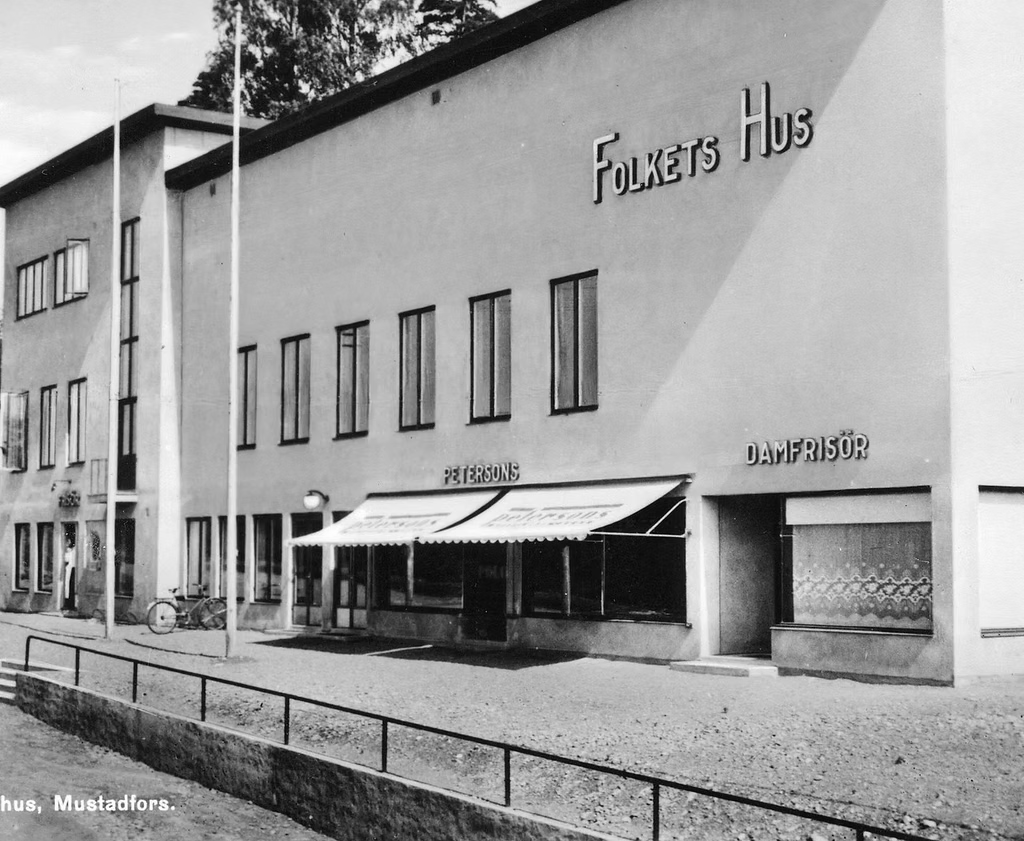
The building does not look imposing. Yet that is precisely where some of its significance lies. It is designed for practical use: with a large hall, additional rooms, a stage and the practical facilities required for a variety of events. One evening, a club might hold a meeting here; on another, there might be dancing, a theatre performance or a concert. Folkets Hus is less a monument than a piece of infrastructure – and perhaps for that very reason a place where history lives on.
The Return of Arne Torger
Arne Torger was born in Dals Långed in 1946. At the age of thirteen, he made his orchestral debut performing Mozart’s Piano Concerto in A major.

Foto: https://www.torger.de/
He studied under Hans Leygraf, first in Stockholm and subsequently in Hanover, and went on to become an internationally renowned concert pianist. For many years, he also taught at music academies, including as a professor in Würzburg and, from 1997 to 2008, at the ‘Franz Liszt’ University of Music in Weimar.
One could simply list these stages: Stockholm, Hanover, Würzburg, Weimar, concerts in many countries. But in the hall at Mustadfors, they took on a different significance. For this career did not begin in a famous concert hall, but in a local hall in a small village in Dalsland.
Between pieces, Torger spoke of his life in music, of teachers, places and experiences. The concert was entitled: ‘Min musikaliska väg från Folkets Hus i Mustadfors till Ca’ Pesaro i Venedig’ – ‘My musical journey from Folkets Hus in Mustadfors to Ca’ Pesaro in Venice’. This title does not simply tell a success story. Rather, it describes a journey between very different worlds – and, at the same time, a return to the starting point.
At Torger’s request, all proceeds from the evening went to Folkets Hus. This did not feel like a mere formality. Rather, it seemed to be a recognition that such places can be crucial to cultural life – even if one only comes to understand their significance many years later.
Music as a journey

The programme ranged from Mozart through Schubert, Chopin, Schumann and Liszt to Debussy. It was not merely a succession of famous piano pieces. The selection opened up various musical worlds: clarity, inner turmoil, images of nature, dreams, love poetry, memories and new beginnings.
To begin with, Torger played the first movement of Mozart’s Piano Sonata in D major, K. 576.
This was followed by Schubert’s *Moments musicaux* in C major and C-sharp minor. I found Chopin’s Second Ballade in F major, Op. 38, particularly striking. It begins calmly, almost idyllically. Yet this calm does not last. Suddenly, a fierce, dramatic movement bursts forth. It was as though a peaceful image had been torn apart, revealing something else: restlessness, resistance, perhaps even despair. Chopin does not tell a story with words here, and yet, as you listen, the impression of a narrative emerges.
Robert Schumann’s *The Bird as Prophet* is one of those pieces that are not easily defined. The music does not sound like a birdcall in the natural history sense. It feels more like a premonition: something that becomes audible for a moment and then slips away again. The title brings to mind nature, but also dreams and omens.
With Debussy’s *La cathédrale engloutie*, the atmosphere changed once more. The piece refers to the legend of a sunken cathedral that emerges from the sea, becomes audible and then returns to the depths. The ‘sunken cathedral’ appeared not merely as an image, but as a memory of something that is there and yet remains out of reach.
Schumann’s *Traumes Wirren* then brought movement and virtuosity. The title is often translated as ‘The Turmoil of Dreams’ or ‘The Confusion of the Dream’. The music rushes, flickers and abruptly takes different directions. It is not calmly dreamy, but full of energy.
Franz Liszt’s *Sonetto 104 del Petrarca* led into a more lyrical mood. Liszt draws on a text by Petrarch; here, the piano almost sings. One hears long melodic lines, passionate crescendos and moments of pause.
To conclude, Torger played Debussy’s *L’isle joyeuse*, inspired by a painting by Antoine Watteau. The music is full of movement, light and colour.
A place that stays with you
As a visitor and new resident of Dals Långed, I didn’t just get to know a pianist that evening. I also learnt a little more about the place where I now live.
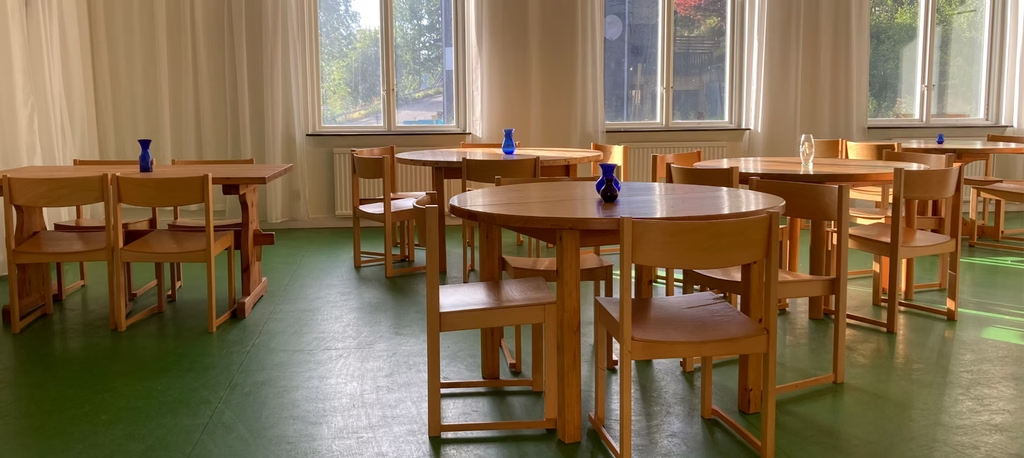
Folkets Hus Mustadfors tells the story of industrial labour and the labour movement, of clubs and local initiatives, of dance, cinema, meetings and culture. It embodies the idea that the public needs spaces that are not driven solely by commercial interests. The fact that a pianist like Arne Torger performed there as a child and returned seventy years later brings this story to life.
Perhaps the special quality of such an evening lies in the fact that it requires no grand production. A hall, a grand piano, an audience, coffee and home-baked cakes in the adjoining room – and a musician returning to the venue of his very first performance. For a few hours, it becomes clear that culture does not arise solely in the big cities. It begins here too: in a Folkets Hus in Dals Långed.